The Art of the Patchwork Sleeve: How to Collect Small Tattoos Without Looking Messy

The Art of the Patchwork Sleeve: How to Collect Small Tattoos Without Looking Messy
When we think of a tattoo sleeve, we often picture a large, cohesive piece: a Japanese Irezumi sleeve flowing with waves and dragons, or a black-and-grey realism arm where every design blends seamlessly into the next.
But in recent years, another style has taken over: the patchwork sleeve.
Inspired by sticker books, vintage sketchbooks, and punk-rock aesthetics, a patchwork sleeve consists of individual, separate tattoos collected over time, separated by clean, blank skin. It is personal, flexible, and incredibly stylish.
However, there is a fine line between a sleeve that looks curated and artistic, and one that looks chaotic and disorganized. Here is the ultimate guide to building a patchwork sleeve that looks intentional and flows beautifully.
What Makes a Patchwork Sleeve Work?
Unlike a traditional full sleeve where the background (like clouds, wind, or smoke) connects everything, a patchwork sleeve relies on negative space and visual rhythm.
The secret to a great patchwork sleeve is not that the tattoos match in subject, but that they share a common visual language.
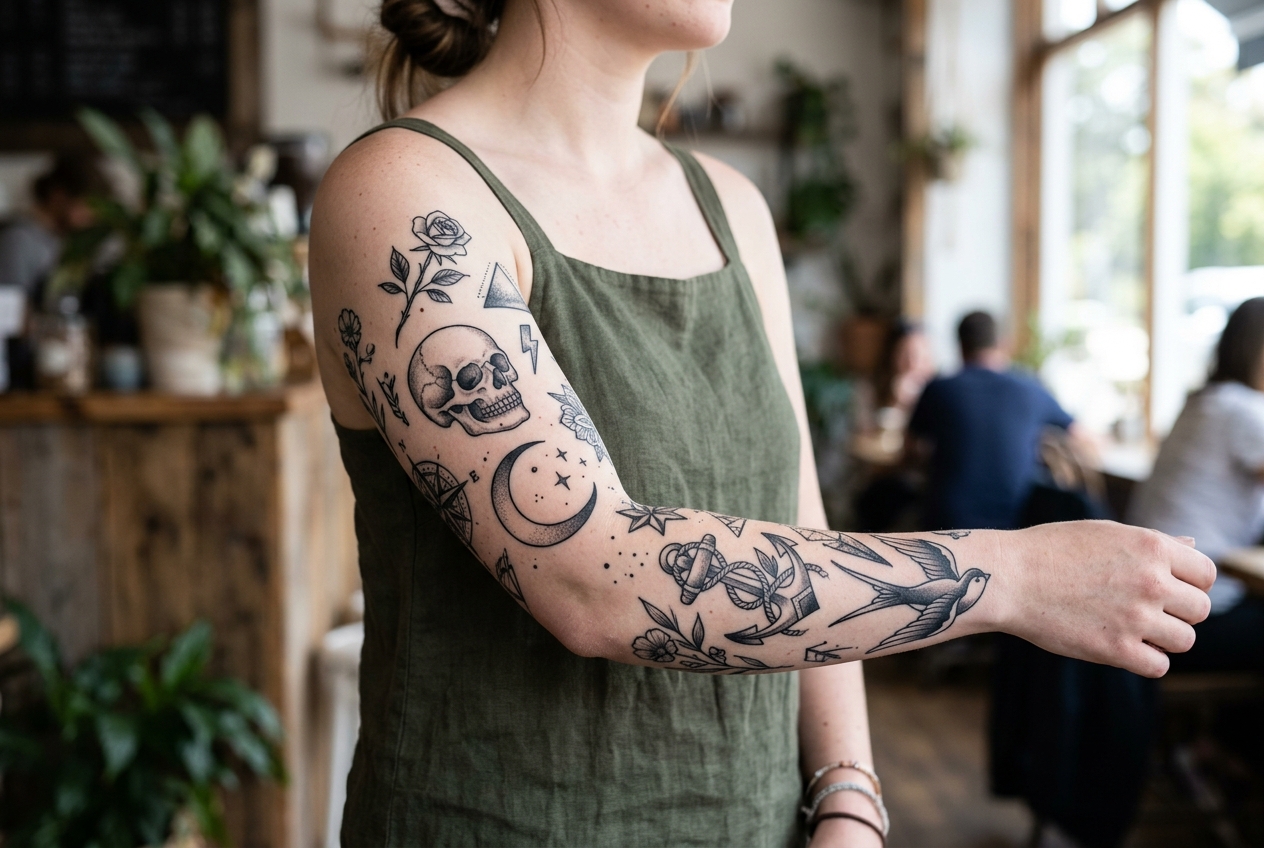
5 Steps to Planning a Cohesive Patchwork Sleeve
If you want to build a patchwork sleeve over time, follow these design principles to ensure your arm flows naturally:
1. Identify Your Anchor Pieces
Start by placing larger, detailed designs on the major "flat" surfaces of your arm. These are your anchors. Good spots for anchor tattoos include:
- The outer bicep
- The forearm (inner and outer flat surfaces)
- The shoulder cap
By placing your largest pieces first, you establish the visual weight of the sleeve.
2. Follow the Body's Flow
Your arm is not a flat canvas; it twists, bends, and tapers. Tattoos should follow the natural musculature of your body. A vertical, linear design (like a dagger or wildflower) flows best on the forearm, while rounded designs (like a compass or skull) sit beautifully on the shoulder or elbow.
3. Maintain Style Cohesion
You don't need all your tattoos to be of the same subject, but keeping the art style consistent holds the sleeve together.
- Linework Weight: A mix of bold American Traditional outlines and hyper-thin micro-realism lines can look discordant if not carefully balanced.
- Color Scheme: Decide early on if you want an all-black-and-grey sleeve, a vibrant full-color sleeve, or a limited color palette (e.g., black and red). Keeping the color scheme uniform is the easiest way to unite different designs.
4. Respect the Negative Space
The blank skin between your tattoos is just as important as the ink itself. Aim for relatively consistent spacing between your designs—typically about half an inch to an inch. If some tattoos are crammed together while others are miles apart, the sleeve can look unevenly distributed.
The Art of the Filler: Connecting the Dots
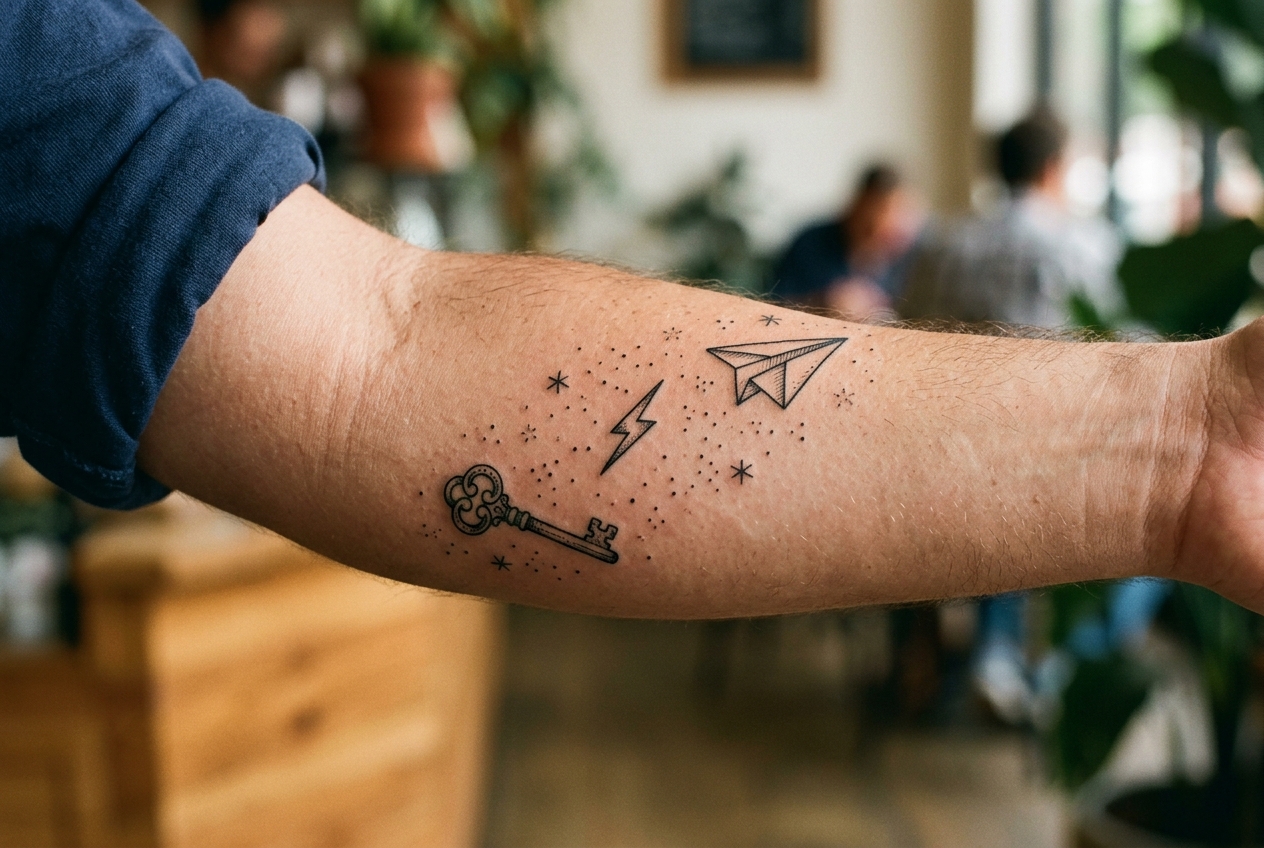
Once your main anchor pieces and medium-sized gap-fillers are in place, you will be left with small, awkward spaces of blank skin. This is where fillers come in.
Fillers are small, simple designs used to bridge the gaps. Popular options include:
- Traditional Stars and Dots: A classic American Traditional technique.
- Botanical Sprigs: Small leaves or vines winding around your main tattoos.
- Sparkles & Astrological Symbols: Clean, modern geometric filler.
Fillers are excellent for tying the sleeve together, but use them sparingly. Leaving pure, clean negative space around your tattoos is what keeps the patchwork aesthetic looking clean and readable.
Golden Rules for the Patchwork Collector
If you're starting your patchwork journey, keep these three rules in mind:
- Don't Rush the Gaps: It can be tempting to fill your arm as quickly as possible. Don't. Part of the charm of a patchwork sleeve is the story behind each piece. Leave spaces open for travel tattoos, guest artists, or sudden bursts of inspiration.
- Consult a Single Artist for Placement: Even if you get tattooed by dozens of different artists, it can be helpful to work with one main artist to map out placement. They can help ensure new pieces flow with your existing ones.
- Embrace the Imperfect: A patchwork sleeve is organic. It doesn't need to be mathematically perfect. A little asymmetry and variety are what make it uniquely yours.
Frequently Asked Questions
How many tattoos does it take to make a sleeve?
Typically, a complete patchwork sleeve consists of 10 to 15 medium-to-large designs, plus small gap-fillers.
Is a patchwork sleeve cheaper than a full sleeve?
Not necessarily. While you pay in smaller increments over time, the total hours and individual setup fees for multiple sessions can add up to be equal to or even more than a single multi-session sleeve.
Can I mix black and grey with color?
Yes, but do it intentionally. For example, you could have a black-and-grey sleeve where every tattoo has a single pop of red, which ties the arm together beautifully.


