White Ink Tattoos: The Honest Truth About How They Heal

White Ink Tattoos: The Honest Truth About How They Heal
If you log onto Pinterest right now and search "white ink tattoo," you will be flooded with images of gorgeous, delicate designs that look like elegant scarification or white lace resting perfectly on the skin.
They are incredibly beautiful. They are also, unfortunately, highly misleading.
Most of the photos circulating online of white ink tattoos are taken immediately after the artist finishes the piece. Once the tattoo goes through the month-long healing process, it undergoes a radical transformation. If you are considering asking your artist for a purely white design, here is the honest truth about the chemistry of white ink.
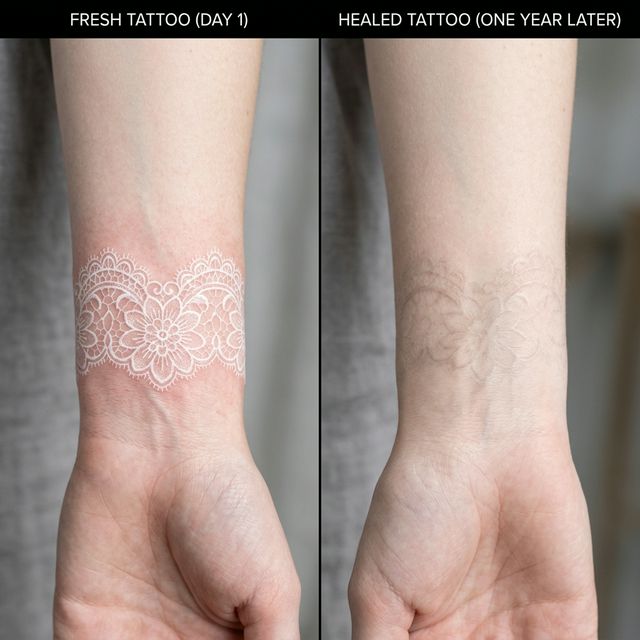
The Myth of Opacity
Tattoo ink does not sit on top of your skin like paint on a canvas. The ink is deposited into the dermis, which is located underneath the epidermis (the top layer of your skin).
This biological reality means that you are always viewing a tattoo through a filter of your own skin tone.
Black ink is so dark and dense that it easily shows through the epidermis filter. White ink, however, is much lighter than human skin.
When a white ink tattoo heals, the epidermis regenerates over top of it. Because the skin barrier has melanin (pigment), it immediately acts as a tinted window over the white ink.
How White Ink Actually Ages
Because of this "skin filter" effect, a white ink tattoo will never remain the stark, typewriter-paper white it appears to be when fresh.
Here is what happens instead:
- On very pale skin: The white ink will heal to look like a slightly raised, silvery, or slightly yellow scar. It becomes extremely subtle and often blends entirely into the background.
- On olive/tan skin: The melanin acting as a filter over the white ink will usually cause the tattoo to look slightly yellow or distinctly beige.
- On dark skin: White ink is notoriously difficult to pack into melanin-rich skin. Often, the healing process causes the white ink to look muted, raised, or to fade entirely within months.
Furthermore, white ink is the least photostable of all pigments. If exposed to UV rays (the sun), white ink has a high tendency to turn a faded, murky yellow-green over a span of five to ten years.
Does White Ink Show Up Under UV Light?
There is a massive misconception that white tattoo ink glows under blacklight. Standard white tattoo ink does not glow in the dark or under UV lights. It will look like a normal (or slightly faded) tattoo.
If you want a tattoo that glows under a blacklight, you must request specific UV-reactive ink. This is a completely different chemical compound that goes into the skin mostly transparent and glows brightly under blacklight. (However, UV inks have a much higher rate of allergic reactions and skin rejection!).
The Best Use for White Ink
Are we saying you should never get white ink? Absolutely not! Every master tattoo artist uses white ink—but they use it strategically.
White ink shines brightest when it is used for highlights. Putting a tiny drop of white ink inside the eye of a traditional panther, or using it to add a reflective glint to a realism portrait, is what makes a tattoo pop off the skin and look 3-dimensional.

When sandwiched heavily by dark contrast colors, white ink holds its ground beautifully. But as a standalone linework piece? Expect a delicate, faded, scar-like look. If that is the aesthetic you are going for, then absolutely book the appointment! Just manage your expectations for the healed result.
Frequently Asked Questions About White Ink
Can white ink be lasered off? White ink is notoriously difficult to laser remove. In fact, the laser can sometimes cause the white pigment (often containing titanium dioxide) to oxidize and instantly turn black or dark grey, making it even worse.
Does white ink hurt more? The ink itself does not hurt more. However, white ink highlights are usually the very last step of a tattoo session, applied to skin that has already been wiped, wiped, and tattooed for hours. The skin is raw, making those final white highlights feel exceptionally spicy.
